This article first appeared on GlobalSpec: https://insights.globalspec.com/article/23669/mcelroy-equipment-plays-part-in-world-cup-pitch-preparation
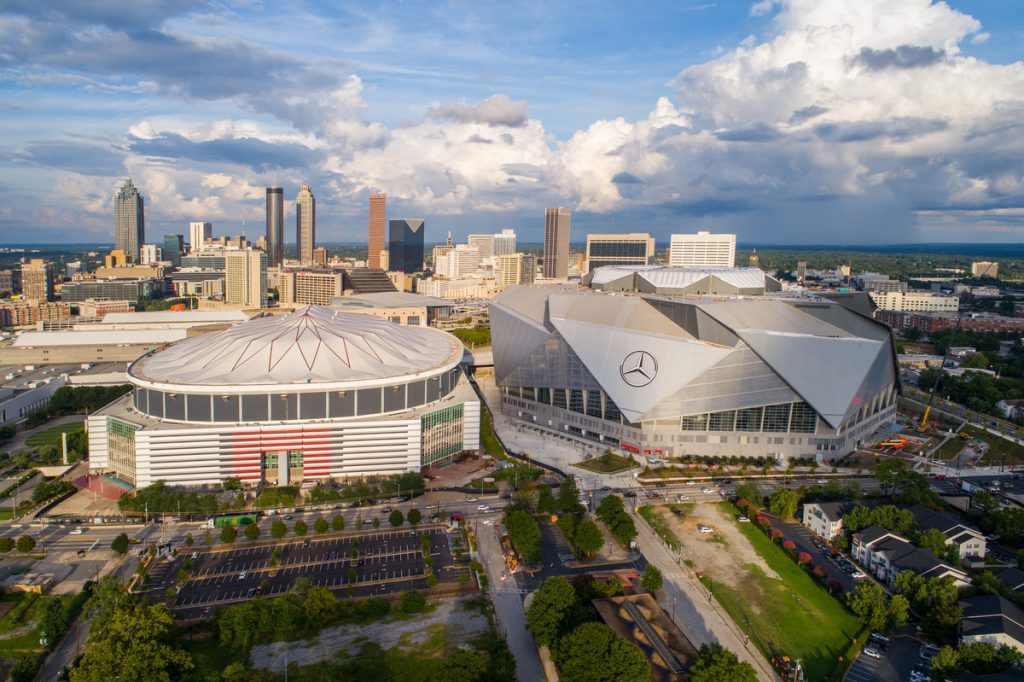
As the U.S. prepares to host the world’s largest sporting event, one company is using McElroy equipment to ensure the irrigation systems where matches will be played are also ready to perform at the top level.
Every four years, the Federation International de Football Association (FIFA) hosts the World Cup, a roughly month-long international soccer competition in which 48 teams vie for the coveted title of World Cup champions.
American football might reign supreme in the U.S., but in many other parts of the world, soccer is king. The World Cup final is the world’s most-watched single sporting event, with literal billions of people watching to see who will be named World Cup champion. According to FIFA, the 2018 World Cup final had an estimated viewership of 3.57 billion — nearly half of the global population at the time.
In 2026, the World Cup will be hosted by three nations: Canada, the U.S. and Mexico. This is the first time since 1999 that the World Cup will be held on North American soil.
It’s not easy to host a World Cup match. Host stadiums must be able to seat at least 40,000 attendees, growing to 60,000 seats for semi-final stadiums and 80,000 seats for the opening and final matches.
Of the 41 cities that submitted a bid to host a 2026 World Cup match, 16 were chosen: two in Canada, three in Mexico and 11 in the U.S. But, there was a stipulation: World Cup matches must be played on natural grass, and half of those 16 stadiums were outfitted with artificial turf. That meant those eight stadiums needed to be fitted with natural grass fields — or pitches, in soccer lingo — to be able to host their matches.
Building a pitch
In Atlanta, Georgia, Precision Turf, LLC had to hustle to do just that at Atlanta’s largest stadium, which currently hosts both the NFL’s Atlanta Falcons and Atlanta United FC, the city’s recently founded Major League Soccer team.
In January 2024, Precision Turf was approached by stadium officials, along with AMB Sports in Atlanta. Precision Turf was familiar with the stadium — the company built the original field in 2017, plus the training grounds for Atlanta United when that team first formed.
“We have a long-standing relationship with the organization,” said Brandon Wilson, a Precision Turf senior project manager.
Founded in 2003, Precision Turf is based out of Atlanta, but has worked across the country on the construction of high-end sports fields.
Building a World Cup pitch isn’t as simple as installing irrigation lines and calling it a day. The line at the Atlanta stadium is a multi-functional irrigation system, complete with a 6 inch HDPE loop that supplies water to a larger irrigation network used by field staff to quickly water the field during pregame and halftime. That existing system is already in place and is used on the artificial turf.
“But we also needed to install upgrades to accommodate the water needs for the 2026 World Cup matches happening in the stadium,” Wilson said. “The natural grass pitch that will be installed ahead of the World Cup will have a full-scale irrigation system to keep the grass alive and thriving indoors.”
A tight timeline
While some projects are measured in months or even years, Precision Turf had just four weeks to install the new in-ground utilities. The stadium, which houses Major League Soccer and National Football League (NFL) teams, had soccer matches scheduled almost immediately after the project’s completion window closed.
“This particular job was very fast-paced, with a narrow window for new inground utility installation,” Wilson said.
Luckily, Precision Turf had a big advantage on their side — the stadium’s overhead roof, which prevented weather delays.
“That was the main factor in keeping the project on schedule,” Wilson said.
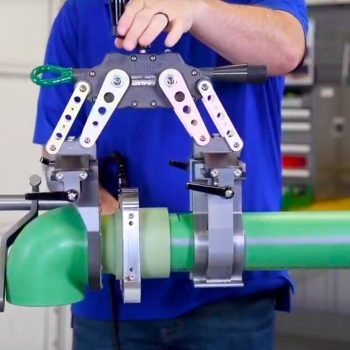
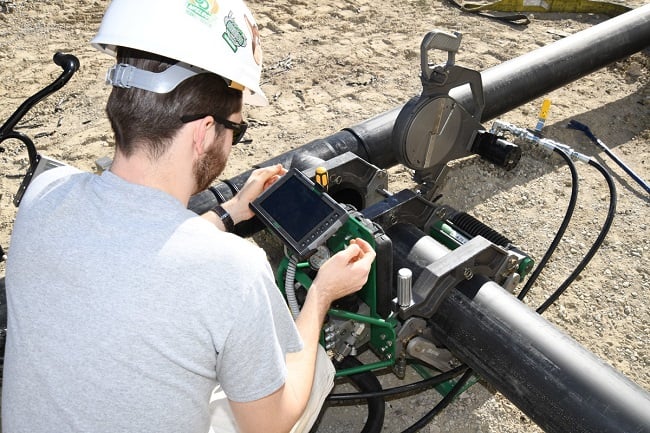
Most of the fusions for the project were done with a Pit Bull 26 and Pit Bull 28. McElroy’s Pit Bull line is built to provide plenty of muscle for fusing small- and medium-diameter pipes in tight spaces or where track-mounted vehicles aren’t necessary. Compact and portable, the Pit Bull carriage is built specifically for in-ditch fusions.
In all, about 75 butt fusions were done during that two-week window, using a 1,300 foot loop of 6 inch SDR 11 HDPE and 40 feet of 8 inch SDR 11 HDPE.
“The machines performed just as we wanted them to,” Wilson said.
A cut above
The World Cup is arguably the world’s largest sporting event, and as such the standards are high for the pitches where matches take place.
“Irrigation requirements are definitely a step above most of the fields in the U.S.,” Wilson said. “FIFA requires every sprinkler head be independently valved, compared to standard-zoned systems with multiple heads per valve.”
Essentially, that requirement allows each sprinkler head to be controlled independently. Which means installing many times more piping in the pitch to accommodate.
Likewise, Wilson and Precision Turf chose HDPE for their piping system because it is also a high-quality irrigation piping material.
“HDPE is a more ‘bullet-proof’ system on high-end, high-volume, high-pressure systems,” he said.
Wilson noted a few of the many other benefits of HDPE as well, such as a thicker pipe wall, glue-free joints and the fact that HDPE irrigation systems don’t require thrust blocking. In non-HDPE systems where fittings are glued in place, thrust blocks are barriers, often made of concrete, that butt against the pipe where it changes direction, dead ends or connects to a valve to reduce the risk of a joint coming apart due to thrust. HDPE butt fusion, on the other hand, provides a fused joint that’s as strong or stronger than the surrounding pipe, canceling out the need for that extra reinforcement.
Precision Turf began using McElroy machinery in 2014, when the company began transitioning its larger irrigation projects from PVC to HDPE. Today, the company has several McElroy machines in its fleet, and it regularly sends personnel for HDPE fusion training and certification.
“We want to ensure we’re delivering the best-quality product to our customers,” Wilson said.
Long after the final whistle blows, the HDPE irrigation systems beneath World Cup pitches in the United States will deliver their same high levels of quality and reliability. And when installed by a qualified operator, using an industry-accepted fusion standard and high-quality equipment, those piping systems will be ready to meet or exceed even the most rigorous of standards for generations to come.