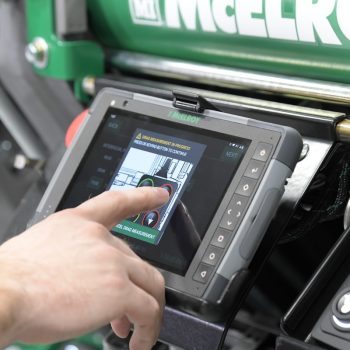
Water piping systems are critical to the world’s infrastructure. Today, those systems are being designed and installed with an eye for sustainability, reliability, and efficiency. Welded HDPE fits all three of those criteria.
When installed with a quality welding machine by a well-trained operator using an accepted standard, welded HDPE joints form a joint that is as strong – or stronger – than the surrounding pipe. Its proven record of reliability is clear in its allowable leakage rate of zero, compared to PVC and ductile iron allowable leakage rates of 10-20 per cent. HDPE’s corrosion resistance, immunity to biological growth, and strong chemical tolerance make it ideal for potable water, wastewater, and mining environments.
According to the Plastics Industry Pipe Association of Australia, the polyethylene pipe industry estimates HDPE pipe to be more than 100 years, providing a tremendous savings in maintenance, both in terms of time, repairs, and wasted water.
Plus, with thermoplastic pipe, installation methods go beyond traditional trench-digging. Eliminating the need for a trench not only reduces the amount of manpower needed for installation – it also minimises the disruptions around the site, such as streets or waterways.
Real-world example
To compensate for the area’s population boom, the City of Gold Coast was recently able to complete a large-scale water recycling network, constructing two of the longest marine pipeline crossings of their kind in all of Australia. By 2050, the area is expected to double to 1.2 million people, meaning the existing infrastructure, installed in the 1980s, was nearing its capacity and needed an overhaul.
Engineers turned to HDPE for the solution. During the first stage of the project, a 1200mm diameter welded HDPE pipeline was pulled under the Nerang River bottom between Winchester Street and Waterways Drive. The pipeline is designed to handle increased volume of wastewater that, after treatment and reclamation, goes on to irrigate golf courses, parks, and more.
The city’s work is ongoing and expansive. According to the City of Gold Coast, plans are underway to connect new drinking water customers in areas that weren’t covered in the first phase of recycled water development. That includes the Gold Coast Botanic Gardens, the Gold Coast Turf Club, and Home of the Arts. In all, the city estimates they’ll be able to save up to 500,000 litres of drinking water per day. From start to finish, traceability and quality control are cornerstones of the poly pipe welding process.
That’s where McElroy’s DataLogger® comes in. Data-logging equipment is an invaluable tool on any welding jobsite, but the DataLogger stands above the rest thanks to its rugged design, innovative features, and its ever-growing functionalities tailored to meet each jobsite’s needs.
The DataLogger captures and records all pertinent data related to each welded joint, including pressures, the standard being used, the joint’s GPS coordinates, and more. Whether you’re performing butt, sidewall, mitered, or dual-containment welding, the combination of the DataLogger software and ruggedized tablet is an invaluable tool for quality assurance and record-keeping in the field.
Functioning alongside the DataLogger is the Vault™, McElroy’s powerful cloud-based storage platform. When connected to the internet, the DataLogger allows users to upload their fusion data into the Vault, allowing for instant review and oversight, whether down the street or miles away. For engineers, managers, and inspectors, that means getting as granular as you want with the data that comes from each weld, with each machine, on each project.
Understanding and using the information provided by the DataLogger can significantly improve the bottom line. The DataLogger gives you the tools to improve decision-making and overall jobsite performance in the field.
In the City of Gold Coast’s recycled water project, GEM Industrial owner Darren Chandler used a DataLogger to record each step of the fusion process. This lets operators know that the correct temperatures, pressures and heating/cooling times were following during the fusion. Chandler said GEM data logs every joint on every job because of the peace of mind and comfort in knowing that the correct procedures were followed.
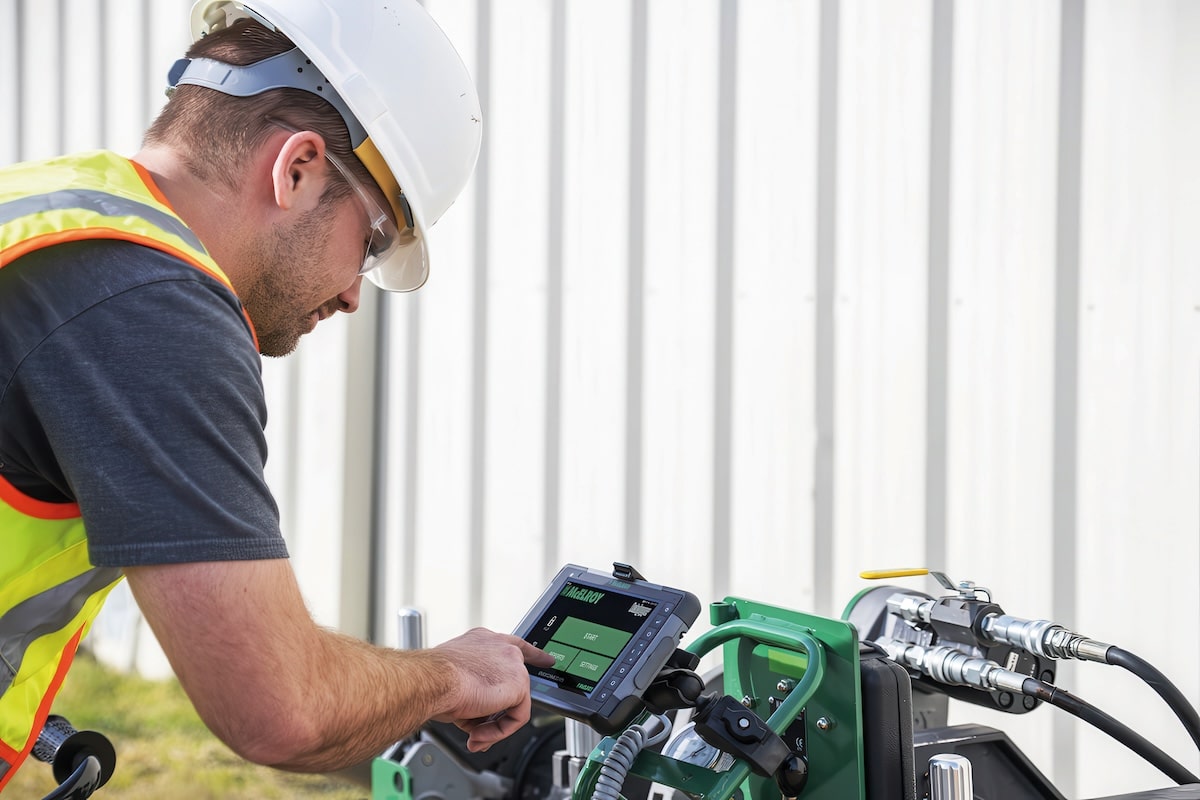
The latest innovations
In February 2026, McElroy officially rolled out two new DataLogger features to assist in identifying related welds in an assembly: Vault ID Tags and Fabrication Workflow.
Vault ID Tags are pre-coded, specially made labels containing QR codes that can be associated with a specific weld. This allows someone to view the weld report just by scanning the QR code on the label attached to the pipe itself.
These labels are UV stable, water resistant, tear resistant, and fade resistant, with a polyethylene- and polypropylene-rated adhesive. The process of assigning a Vault ID Tag is simple: after performing the fusion as normal with the DataLogger tablet, the operator will scan the label to associate it with the Vault record.
Once the information has been uploaded, the report can be viewed by anyone who scans the label with any device.
Even better: no custom app is required, and the open URL allows any device to access the joint report – even without a Vault account.
Fabrication Workflow is an extension of the standard DataLogger workflow to include additional data that relates different joints together. The features of the fabrication workflow were designed for the needs of prefabricated pipe manufacturers but can be used effectively for a number of situations where multiple welds need to be related to each other.